In one line: MD5 is a hash function that turns any input into a fixed 128-bit digest (32 hex characters). It is no longer safe for security, but still fine for catching accidental corruption.
How I think about it
input  ──►  [ hash function ]  ──►  digest / hash value
                                    (always 128 bits long)
MD5 stands for Message Digest 5. Whatever goes in, a short sentence or a whole file, the same-sized fingerprint comes out. The same input always gives the same digest, and changing even one character gives a completely different one.
Inside, MD5 thinks in words: a word is a chunk of 32 bits. It reads its input 16 words at a time (32 × 16 = 512 bits) and its answer is 4 words (32 × 4 = 128 bits).
Why 128 bits is 32 hex characters
- One bit is a
0or a1. - Hexadecimal has 16 digits (
0–9,a–f), and 16 = 2⁴, so one hex digit holds exactly 4 bits. - 128 bits ÷ 4 = 32 hex characters, which is why an MD5 hash is always 32 characters long.
- Binary would be 128 characters long, so hashes are shown in hex. In code, the prefix
0x(as in0x01234) marks a number as hex.
There are 2¹²⁸ ≈ 3.4 × 10³⁸ possible MD5 digests.
How MD5 works
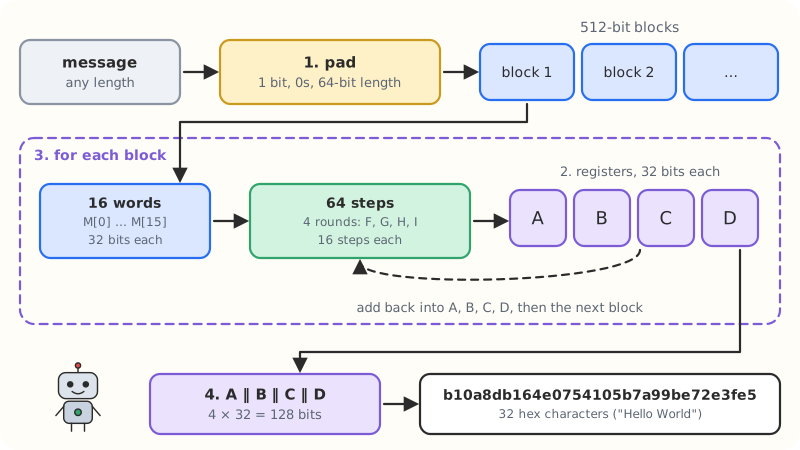 From any input to a 128-bit digest: pad, split into blocks, mix each block into four registers.
MD5 accepts input of any length and works through it 512 bits at a time. Padding is always added, even to a message that is already exactly 512 bits long (it gets a second block), and it is more than zeros: a 1 bit, then zeros, then the original length.
The simple version of the algorithm:
- Pad the message. Append one
1bit, then0bits until the length is 64 bits short of a multiple of 512, then append the original length as a 64-bit number. The padded message is now a whole number of 512-bit blocks. (“Hello World” is 88 bits, so it gets 1 + 359 + 64 bits and becomes exactly one block.) - Start four registers. A, B, C and D are 32-bit words with fixed starting values:
0x67452301,0xefcdab89,0x98badcfe,0x10325476. - For each 512-bit block:
- Split the block into 16 words,
M[0]toM[15]. - Copy A, B, C, D into working variables a, b, c, d.
- Run 64 steps, in 4 rounds of 16. Each round uses its own mixing function of b, c and d:
- F =
(b & c) | (~b & d)(rounds 1–16) - G =
(b & d) | (c & ~d)(17–32) - H =
b ^ c ^ d(33–48) - I =
c ^ (b | ~d)(49–64)
- F =
- Add a, b, c, d back into A, B, C, D (each addition wraps around at 2³²).
- Split the block into 16 words,
- Output A, B, C and D one after another: 4 words × 32 bits = the 128-bit digest.
One step, up close
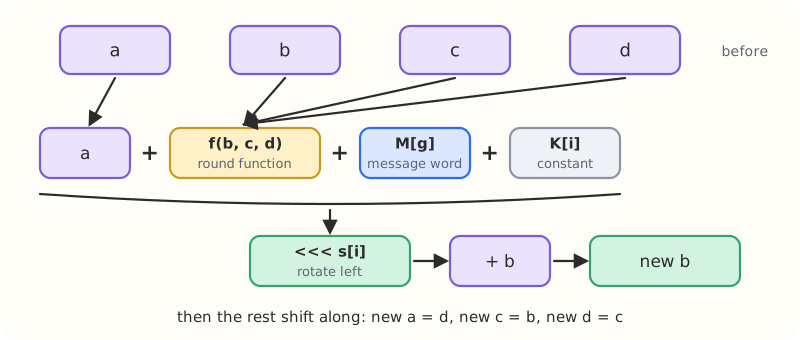 Every one of the 64 steps uses only the operations from my notes: AND, OR, XOR, NOT, rotate and add.
Each step mixes one message word into the registers:
new b = b + ((a + f(b, c, d) + M[g] + K[i]) <<< s[i])
new a, new c, new d = d, b, cM[g]is one of the 16 message words; each round reads them in a different order, so every word is used 4 times.K[i]is a constant for stepi: the first 32 bits of the fractional part of |sin(i + 1)|, which is just a way to get 64 numbers that look random but anyone can recompute.s[i]is how far to rotate, which changes from step to step.
The operations
MD5 only uses cheap operations on 32-bit words:
| Operation | Symbol | What it does |
|---|---|---|
| OR | | | 1 if either bit is 1 |
| AND | & | 1 only if both bits are 1 |
| XOR | ^ | 1 if the bits differ |
| NOT | ~ | flips every bit (the MD5 paper writes it as ¬) |
| Rotate left | <<< | shifts bits left; bits pushed off the end come back in on the right |
| Add | + | adds, wrapping around at 2³² |
Bitwise NOT is ~ in code. Don’t confuse it with !, which is logical not (true/false) in languages like C.
Rotation can look like it did nothing: 110110 <<< 3 is still 110110, because the pattern repeats every 3 bits. A clearer example: 110100 <<< 3 = 100110. The leading 110 wraps around to the end.
Example: hashing in Python
import hashlib

hashlib.md5("Hello World".encode("utf-8")).hexdigest()
# 'b10a8db164e0754105b7a99be72e3fe5' (32 hex characters).encode("utf-8")turns the text into bytes. Hash functions work on bytes, not on text.hashlib.md5(...)computes the 128-bit digest (16 bytes)..hexdigest()shows those 16 bytes as 32 hex characters, because raw binary is long and unreadable.
MD5 from scratch
The whole algorithm above fits in a short function. This version gives the same answers as hashlib:
import math
import struct

def md5(message: bytes) -> str:
    rotate = lambda x, n: ((x << n) | (x >> (32 - n))) & 0xFFFFFFFF
    K = [int(abs(math.sin(i + 1)) * 2**32) & 0xFFFFFFFF for i in range(64)]
    S = [7, 12, 17, 22] * 4 + [5, 9, 14, 20] * 4 + [4, 11, 16, 23] * 4 + [6, 10, 15, 21] * 4
    A, B, C, D = 0x67452301, 0xEFCDAB89, 0x98BADCFE, 0x10325476

    # 1. Pad: a 1 bit (0x80), zeros, then the original length in bits.
    length = len(message) * 8
    message += b"\x80" + b"\x00" * ((56 - (len(message) + 1) % 64) % 64)
    message += struct.pack("<Q", length)

    # 2. Mix each 512-bit block (64 bytes) into A, B, C, D.
    for start in range(0, len(message), 64):
        M = struct.unpack("<16I", message[start:start + 64])
        a, b, c, d = A, B, C, D
        for i in range(64):
            if i < 16:
                f, g = (b & c) | (~b & d), i
            elif i < 32:
                f, g = (d & b) | (~d & c), (5 * i + 1) % 16
            elif i < 48:
                f, g = b ^ c ^ d, (3 * i + 5) % 16
            else:
                f, g = c ^ (b | ~d), (7 * i) % 16
            f = (f + a + K[i] + M[g]) & 0xFFFFFFFF
            a, d, c = d, c, b
            b = (b + rotate(f, S[i])) & 0xFFFFFFFF
        A, B, C, D = [(x + y) & 0xFFFFFFFF for x, y in zip((A, B, C, D), (a, b, c, d))]

    # 3. The digest is A, B, C, D written out byte by byte, little-endian.
    return struct.pack("<4I", A, B, C, D).hex()

md5(b"Hello World")  # 'b10a8db164e0754105b7a99be72e3fe5'
MD5 stores numbers little-endian (least significant byte first), which is why the code uses < in struct.
Is MD5 still safe?
- Not for security. Researchers can now create collisions, two different inputs with the same MD5 digest, in seconds on an ordinary computer. Anything that relies on MD5 to stop tampering (signatures, certificates, password storage) can be fooled.
- The 128-bit size is a limit too. Because of the birthday paradox, a collision is expected after about 2⁶⁴ tries, not 2¹²⁸, which is too few for a modern security hash.
- It was once used as a cryptographic checksum, to prove a file had not been tampered with.
- It is still fine for error detection: spotting accidental corruption in a download or a copied file, where nobody is trying to cheat.
- Alternatives: for security, use SHA-256 (from the SHA-2 family) or SHA-3. Avoid SHA-1 too: it is broken as well, and the first practical collision was published in 2017. For catching accidental errors only, MD5 or a CRC is enough; neither gives any security.
Further explanation
- Video: How the MD5 hash function works (from scratch) by RareSkills walks through the algorithm step by step.
My notebook pages
The handwritten pages this note was written from. Click a page to open it full size.
Show the three notebook pages
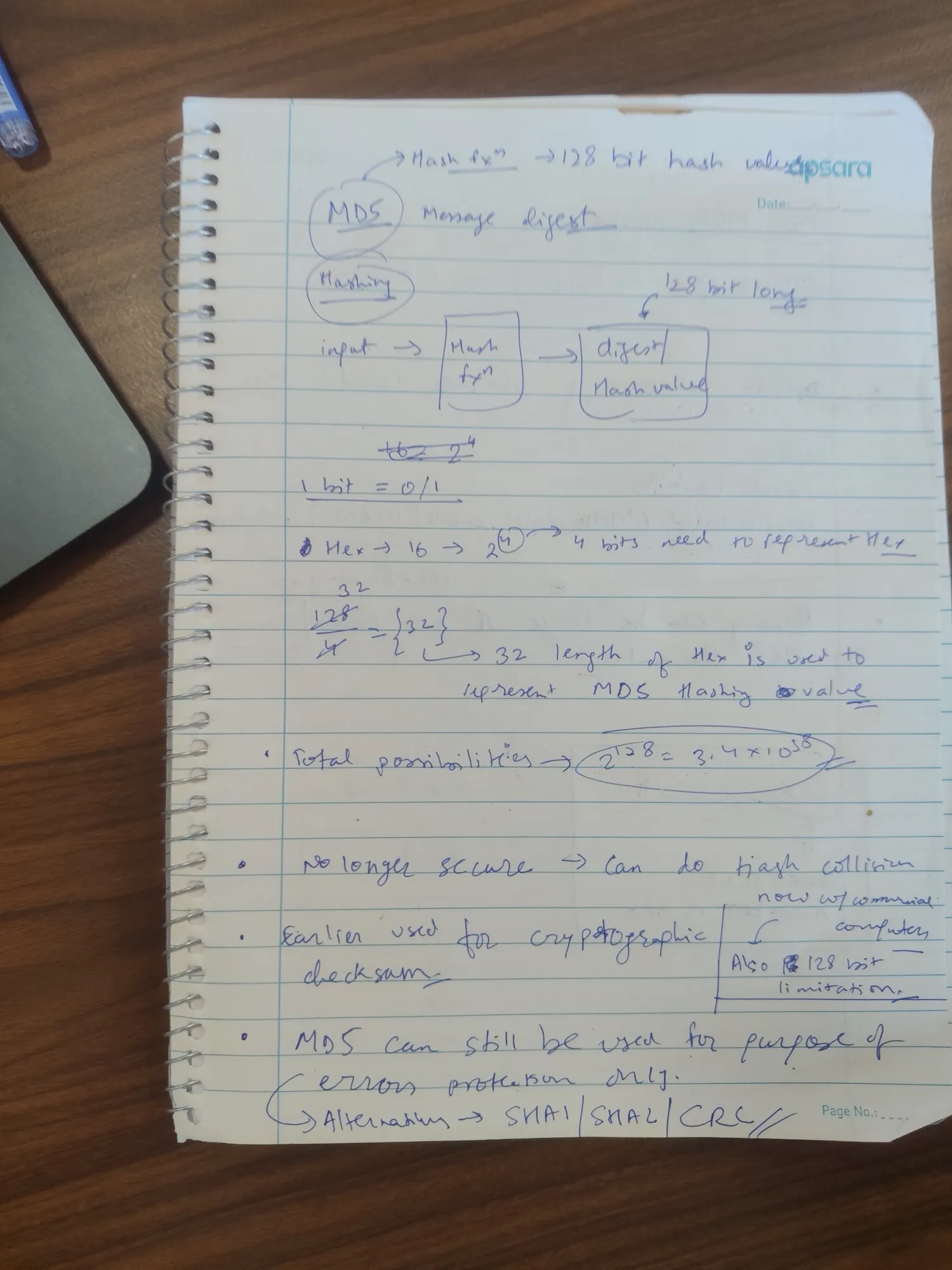 Page 1: what MD5 is, hex length, and why it is broken.
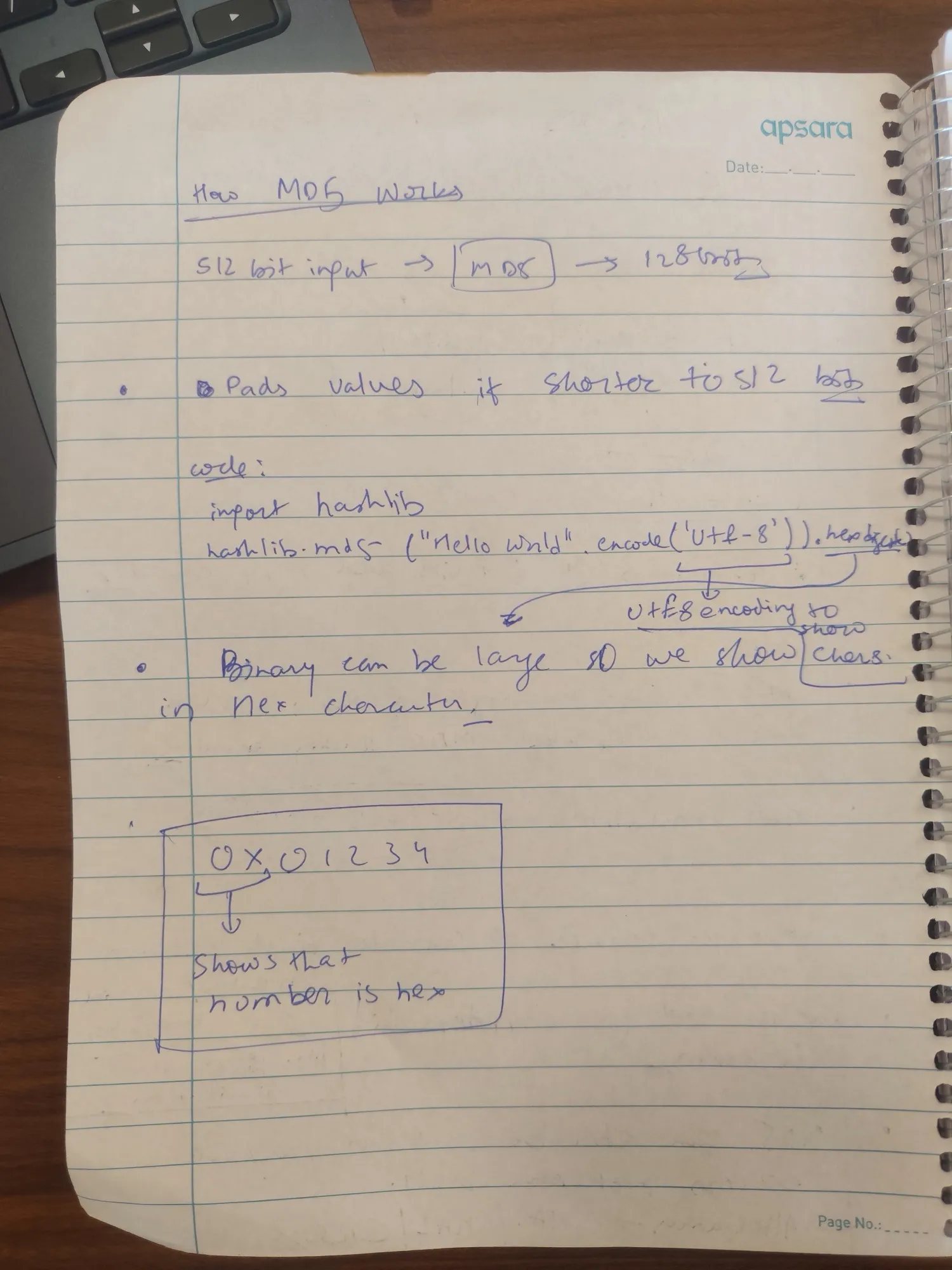 Page 2: padding, the Python example, and hex notation.
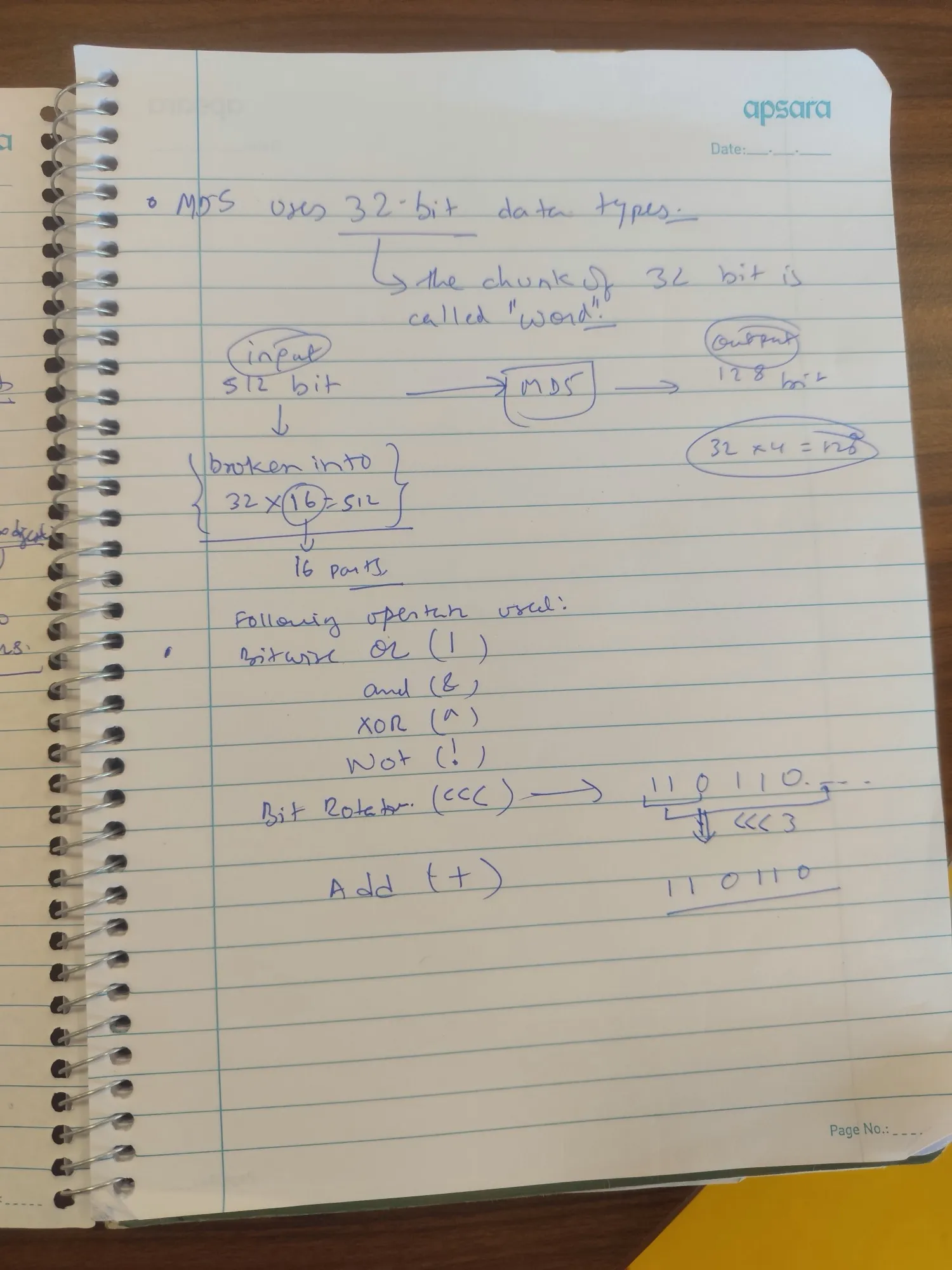 Page 3: words, blocks and the operations.
Revision
Key takeaways
- MD5 maps any input to a 128-bit digest, written as 32 hex characters (4 bits per hex digit).
- It pads the message to whole 512-bit blocks, splits each block into 16 32-bit words, and mixes them into four registers over 64 steps.
- Every step uses only AND, OR, XOR, NOT, rotate-left and addition modulo 2³².
- MD5 is broken for security because collisions are practical. Use SHA-256 or SHA-3 for security, and keep MD5 or CRC for spotting accidental corruption only.
Check yourself
Why is an MD5 hash always 32 characters long?
The digest is 128 bits, and each hex digit holds 4 bits (16 = 2⁴), so 128 ÷ 4 = 32 hex characters.
A message is exactly 512 bits long. How many 512-bit blocks does MD5 process?
Two. Padding is always added: a 1 bit, zeros, and a 64-bit length, so a 512-bit message becomes 1024 bits.
What does .encode("utf-8") do before hashing, and what does .hexdigest() do after?
.encode() turns text into bytes, because hash functions only work on bytes. .hexdigest() turns the 16-byte digest into 32 readable hex characters.
What is 110100 <<< 3 as a 6-bit value?
100110. The first three bits 110 move to the end.
You need to check a download was not corrupted on a flaky network. Is MD5 acceptable? What if an attacker could swap the file?
For accidental corruption, yes. If someone could tamper with the file, no: use SHA-256, because MD5 collisions can be created on purpose.
History
- 2026-10-27: First notes, from three notebook pages on MD5 and the RareSkills video; added the step-by-step algorithm and a from-scratch implementation. The original pages are kept under My notebook pages.